

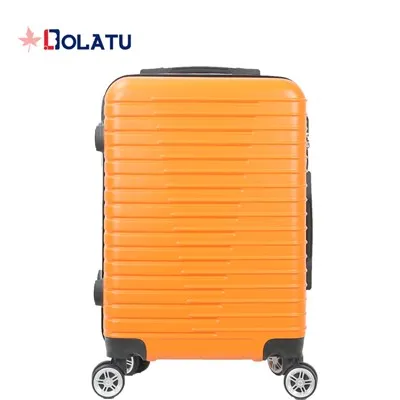
ABS Luggage
Bolatu Company's business address is 58 Nanhuang Road, Zhongtang Town, Dongguan City, covering an area of 17,000 square meters, set up 8 production lines, the number of employees 220 people, the annual production volume of more than 1,500,000 PCS, and has passed the BSCI certification, Sedex certification and ISO 9001 quality system certification.
Bolatu Company have cooperated with international brands such as ELLE, Kumamoto Bear, Woodpecker, Snoopy, Hello Kitty, Disney, Swiss Army knife, etc. Our products not only cover all parts of China, but also exported overseas, Europe, America, Southeast Asia, India, South Africa, the Middle East and other countries and regions, achieving an annual export volume of more than 1,000,000 PCS.
Why Choose Us
Competitive Price
We offering a higher-quality product or service at an equivalent price. As a result we have a growing and loyal customer base.
After-sale service
Professional and thoughtful after -sales team, let you worry about us after -sales Intimate service, strong after -sales team support.
Quick transportation
We cooperate with professional sea shipping, air and logistics companies to provide you with the best transportation solution.
Professional solution
With rich experience and one-to-one service, we can help you choose products and answer technical questions.


What Is ABS Luggage?
ABS (Acrylonitrile Butadiene Styrene) is a common thermoplastic polymer used in hard cover luggage. It is lightweight and durable, but not as strong as other materials. Due to the non-flexible nature of ABS, these suitcases have a higher tendency to develop cracks in the hard case. ABS is also prone to scratching and scuffing.
Benefits of ABS Luggage
Impact resistance
Unlike suitcases made of low-quality plastic, an ABS suitcase won’t look deformed on the baggage carousel. This thermoplastic has a high impact resistance, allowing it to withstand casual mishandling situations, particularly those that occur at airports.
Affordability
ABS’s physical and mechanical properties enable it to be easily machined, which reduces manufacturing costs. Its components are also easily obtained, making ABS a widely accessible material.
Durability
ABS luggage is known for its durability. It is resistant to wear and tear, and protects your belongings from the bumps and bruises of travel.
Lightweight
ABS luggage is lightweight, which makes it easy to carry and travel with.
Water-resistant
ABS is a water-resistant material, which means that your belongings will remain protected even if it rains or you accidentally spill a drink on your luggage.
Scratch-resistant
ABS luggage is also scratch-resistant, so even when it gets bumped around or stacked in the overhead bin, it won't show those ugly marks.

As a travel bag
The first use is also the most obvious one. Yes, for carrying your luggage during your holiday trips i.e. while traveling. Depending on the type and amount of luggage you need to take with you, a suitable type of ABS luggage is chosen. For short trips, small ABS luggage would suffice while heavy or huge amounts of luggage would call for big ABS luggage.
As a storage bag at home
Suppose you have some unused clothes at home which is taking up much of the space in your cupboard. In such cases, we can efficiently make use of these ABS luggage to hold these unnecessary items. It makes more space in your cupboard while keeping your room neat and clean.
Zipper to suitcase liner:The piece of a zipper that you pull in order to unzip the closure is called a zipper pull. In this case, pulling on the zipper pull often unzips the entire length of the suitcase liner and reveals a pocket between the liner and the outer shell.
Suitcase liner: A soft, smooth liner. It should feel slightly slick. High thread-count polyester fabrics can even provide a degree of moisture barrier between sections of the suitcase. This helps to keep that smelly, dirty clothes odor out of the main compartment when using the suitcase liner as a pocket.
Lid compartment:Not all suitcases have a lid compartment, but many modern suitcases include a zippered partition separating the lid compartment from the body of the suitcase. The lid compartment can be an easy way to organize your stuff during a trip.
Telescoping handle:The telescoping handle clicks up and down into place using a release button. When pushed all the way down flush with the top of the suitcase, the telescoping handle should remain in place with only the rigid handle visible. When the release button is pressed and the handle is pulled, the telescoping handle should pull upwards, allowing the bag to be rolled easily without stooping.
Telescoping suitcase handles may have one or two support pieces. These pieces slip into channels in the bottom of a suitcase, which can usually be felt under the suitcase liner when the suitcase is open.
Button to collapse roller handle:This part is especially important because it allows the repositioning of the telescoping handle. When a button to collapse or extend a telescoping handle breaks, often the pull-out handle has to be replaced or the suitcase repurposed for other uses (such as storage or as a secondary suitcase).
Outer shell:Suitcases have various forms of outer shells.
Carry strap:It could be argued that the most important part of a suitcase. Most suitcases have a carry strap on two sides- the top and t on the side opposite the zipper’s hinge. These carry straps are really important. While you may not handle your suitcase by these handles often (most travelers use the telescoping handle primarily), the carry strap is what baggage handlers at airports, valets at hotels, and couriers for trains, buses, and group tours will use to move your suitcase around. For this reason, this part of a suitcase is important and needs to be especially sturdy.
Combination lock:Many modern suitcases come with integrated locks.
Spinner wheels:Arguably the most important development in suitcase research and design in the last 50 years, spinner wheels are, in this pro traveler’s opinion, an important suitcase part. Spinner wheels, rather than set wheels (which only roll in one direction), allow you to maneuver around obstacles easily.
ABS stands for Acrylonitrile Butadiene Styrene. It is an impact-resistant engineering thermoplastic. It has an amorphous polymer. ABS is made up of three monomers: acrylonitrile, butadiene, and styrene:
Acrylonitrile: It is a synthetic monomer. It is produced from propylene and ammonia. This component contributes to the chemical resistance & heat stability of ABS.
Butadiene: It is produced as a by-product of ethylene production from steam crackers. This component delivers toughness & impact strength to ABS polymer.
Styrene: It is manufactured by dehydrogenation of ethyl benzene. It provides rigidity & processability to ABS plastic.
Process of ABS Luggage
Raw material selection
The meticulous selection of raw materials is the first step in the procedure. Acrylonitrile, butadiene, and styrene—the three main ingredients of ABS—are obtained and measured exactly. These ingredients are frequently supplied in pellets or granules, each of which has unique qualities that are essential to the finished luggage’s attributes.
Mixing and compounding
Following their collection, the raw components go through a careful mixing and compounding procedure. Acrylonitrile, butadiene, and styrene are distributed uniformly throughout the ABS blend thanks to this step. Producing luggage with balanced qualities, like as strength, flexibility, and impact resistance, requires achieving a constant composition.
Polymerization
After that, the blended ABS material goes through a procedure known as polymerization. In order to start the chemical processes that result in the formation of the polymer chains, the mixture must be heated. A robust and stable ABS polymer matrix is created thanks to the regulated polymerization process.
ABS sheet extrusion
After that, sheets of the resultant ABS polymer are extruded. To create thin, flat sheets, the molten ABS is forced through a die in this procedure. Because these sheets’ thickness can be carefully regulated, luggage producers may customise the material to fit a variety of bag sizes and styles.
Molding techniques
A crucial stage in the production process is moulding, which forms the ABS sheets into the recognisable shells that distinguish luggage. In the fabrication of ABS luggage, two main moulding processes are often employed:
- Melted ABS is poured into a mould cavity using an injection moulding process, which is widely used. The luggage shell’s intended form is reflected in the mold’s design. The finely moulded baggage casing is visible when the mould is opened once the ABS has cooled and solidified.
- Thermoforming: This process entails heating ABS sheets to a flexible temperature and then using pressure or vacuum to press them into a mould. This method is frequently applied to the moulding of bulky, intricate luggage parts. The luggage shell’s exquisite detailing and distinctive shapes may be created using thermoforming.
- Cooling and finishing: To guarantee structural integrity, the freshly created luggage shells go through a regulated cooling procedure after moulding. The shells may go through other finishing procedures, such cutting away extra material and smoothing the edges, once they have cooled. This stage guarantees a polished and visually appealing finished result.
Assembly
Complete luggage units are then built from the moulded and finished ABS shells. Attaching handles, zippers, wheels, and other parts that enhance the luggage’s usability and convenience is part of the assembling process.
Quality control
An essential component of the manufacturing process is quality control. Every piece of ABS luggage is put through rigorous testing to make sure it satisfies industry requirements for weight, durability, impact resistance, and overall performance. This entails impact and stress testing as well as assessments of the material’s resilience to environmental variables and scratches.
How to Maintain ABS Luggage
Cleaning: Regular cleaning is essential to keep your suitcase tidy. Dust and stains can accumulate during use, so use a soft cloth to clean gently and avoid using a hard brush or strong corrosive cleaners. For stubborn stains, you can also use some neutral detergents, such as household detergents. After using the detergent, remember to rinse the cloth well and then wipe the box dry so that the detergent does not remain. Cleaning the inside of the suitcase is relatively simple. You can use a vacuum cleaner or a damp cloth to wipe it off. It is not recommended to use any detergent to dry metal parts inside and outside the box. After cleaning, wipe the metal parts with a dry cloth to prevent damage to the outer coating or oxidation and rust.
Wheel lubrication: Regularly apply an appropriate amount of lubricating oil to the wheel to ensure smooth rolling and prevent rust.
Maintenance of telescopic rod: Regularly check whether the tie rod is loose or bent. If there is any abnormality, it must be adjusted or repaired in time.
Storage: When the suitcase is not in use, in order to prevent mold, it must be stored in a dry, cool place, away from direct sunlight and moisture. Because prolonged exposure can lead to fading and material damage. The suitcase must be placed upright and nothing should be pressed against it so that it does not deform. When not in use, cover the suitcase with a dust bag or plastic bag to prevent dust accumulation. Otherwise, years of dust seeping into the surface can create future cleaning challenges.
When comparing the merits of ABS vs polycarbonate as suitcase materials, who comes out on top?
From a purely functional perspective, polycarbonate luggage is the best option. While ABS is undoubtedly a tough plastic, polycarbonate has over twice the impact strength. Considering the rough treatment a suitcase experiences over the course of a holiday (thrown onto conveyor belts, stacked on luggage carts, dragged up hotel stairs), durability is an invaluable trait. The longevity of polycarbonate suitcases will also save you money over time, as you will be required to replace them less frequently.
Structurally, the elasticity of polycarbonate makes it easy to fix the shell indentations that can naturally form over time. But ABS — a rigid material — is more likely to crack under pressure. It’s also worth noting that ABS is also susceptible to UV radiation, meaning that direct sunlight will cause it to degrade and even take on a yellow hue over time. In contrast, polycarbonate has a high resistance to UV rays.
Weight is another factor where polycarbonate has the edge. You can broadly expect a polycarbonate carry-on case to weigh around 1kg less than an ABS alternative. That’s the equivalent of 5-6 cotton T-shirts — certainly not a negligible amount.
If affordability is a key consideration, ABS luggage has the advantage. ABS is relatively easy to manufacture and accordingly cheap — it costs around half the price of polycarbonate. Many smaller, less-distinguished luggage brands opt to work with ABS due to the lower cost of production. However, this advantage has to be set against the (often) inferior shelf life of ABS suitcases.
Things to Consider When Buying Hard Shell Luggage


More careful about buying hard-shell luggage, just because often the cheaper suitcases can break after one or two trips. If you’re getting a cheap suitcase, it’s better to buy a fabric one with skate wheels.
Choose polycarbonate or aluminum. Most of the time, polycarbonate is the best option because it’s moderately priced and durable.
Buy a case with a scratch-resistant finish. All the glossier models get scratched just after a few trips. Instead, get a patterned finish.
Some manufacturers make incredibly heavy hard side suitcases. So be sure to check the weight before buying.
Make sure the dimensions are correct. Ideally, you want hard side carry-ons to be below 22 x 14 x 9 inches with the wheels and handles included. Often, the dimensions listed are without wheels and handles, so make sure to get the correct dimensions.
Read the reviews first. Often cheap hard-side suitcases get cracks, broken spinner wheels, broken handles, and broken zippers. Make sure to spend five minutes reading the reviews before buying.
Get a case with expandable width and TSA-approved locks. For new hard-side suitcases, these features are a must-have.
You can solve some small defects in your suitcase yourself. It is at least worth trying as this is still faster than sending your suitcase back.
The zipper of your suitcase is stuck and does not want to open any more. Do not panic. All you need is something 'greasy' such as labello, a bar of soap or Vaseline. Rub the 'teeth' of the zipper with this and then gently move the zipper from left to right. Then carefully pull the zipper and if it is good you will see that the zipper opens and closes again.
There is a dent in your ABS material case. How do you get this dent again? All you need is a hair dryer with 1600 watts of power. Hold the hair dryer for about 15 minutes where the dent is, as soon as the place is warm enough the material will restore itself to its original shape. By the way, do not use a hammer to repair the dent.
The hair dryer technique can also be used for dents on your ABS case. Heating the spot will reduce the white line.
You remove your suitcase from the baggage claim and you can see that your suitcase is completely under the black stripes. These stripes are easy to remove. A bottle of petrol and an old tea towel do wonders. Pour some petrol on the tea towel and gently rub the stripes, you will see that the stripes disappear like snow in front of the sun. This is not recommended for textile cases. The oil causes stains.
The telescopic pull rod no longer slides in and out smoothly. This can be solved by using a drop of oil or Vaseline. First slide the tie rod completely out and then lubricate the lower and middle section of the drawbar with oil or petroleum jelly. Then slide the tie rod in and out a few times so that the oil or petroleum jelly can spread. Be careful with textile cases, the oil can cause stains.
Our Factory
Bolatu Company have cooperated with international brands such as ELLE, Kumamoto Bear, Woodpecker, Snoopy, Hello Kitty, Disney, Swiss Army knife, etc. Our products not only cover all parts of China, but also exported overseas, Europe, America, Southeast Asia, India, South Africa, the Middle East and other countries and regions, achieving an annual export volume of more than 1,000,000 PCS.


FAQ
Q: Which is better ABS or polycarbonate?
Q: Does ABS luggage crack easily?
It is lightweight and durable, but not as strong as other materials. Due to the non-flexible nature of ABS, these suitcases have a higher tendency to develop cracks in the hard case. ABS is also prone to scratching and scuffing.
Q: Which suitcase material is best for international travel?
Q: Is ABS luggage worth it?
Q: What color of luggage is best?
Q: Is it better to have hard or soft luggage?
Q: What size luggage is best for international travel?
Q: Why is ABS so cheap?
Q: Is ABS high quality?
Q: Are 2 or 4 wheel suitcases better?
Q: Are ABS suitcases durable?
Q: Which is better ABS or polypropylene luggage?
As one of the leading abs luggage manufacturers and suppliers in China, we warmly welcome you to wholesale bulk cheap abs luggage from our factory. All customized products are with high quality and competitive price. Contact us for pricelist.
Multi Color ABS Unisex Luggage, Sets 3 Pieces Trolley Luggage Bags with Wheels, Carry on ABS luggage